


KXAN: Native women-led Texas Tribal Buffalo Project seeks to ‘rematriate’ prairie, help their communities
AUSTIN (KXAN) — The nonprofit Texas Tribal Buffalo Project seeks to repopulate the American bison while also uplifting the state’s Native American communities.
Lucille Contreras, the project’s CEO, started the work in 2020. She’s Lipan Apache, a tribe recognized by Texas but currently lacks federal status.
“Our mission and our goals are to reconnect Texas Indigenous lineal descendants to each other by rekindling our kinship as relatives to each other and our relationship to the buffalo as a relative,” she told KXAN on Wednesday.
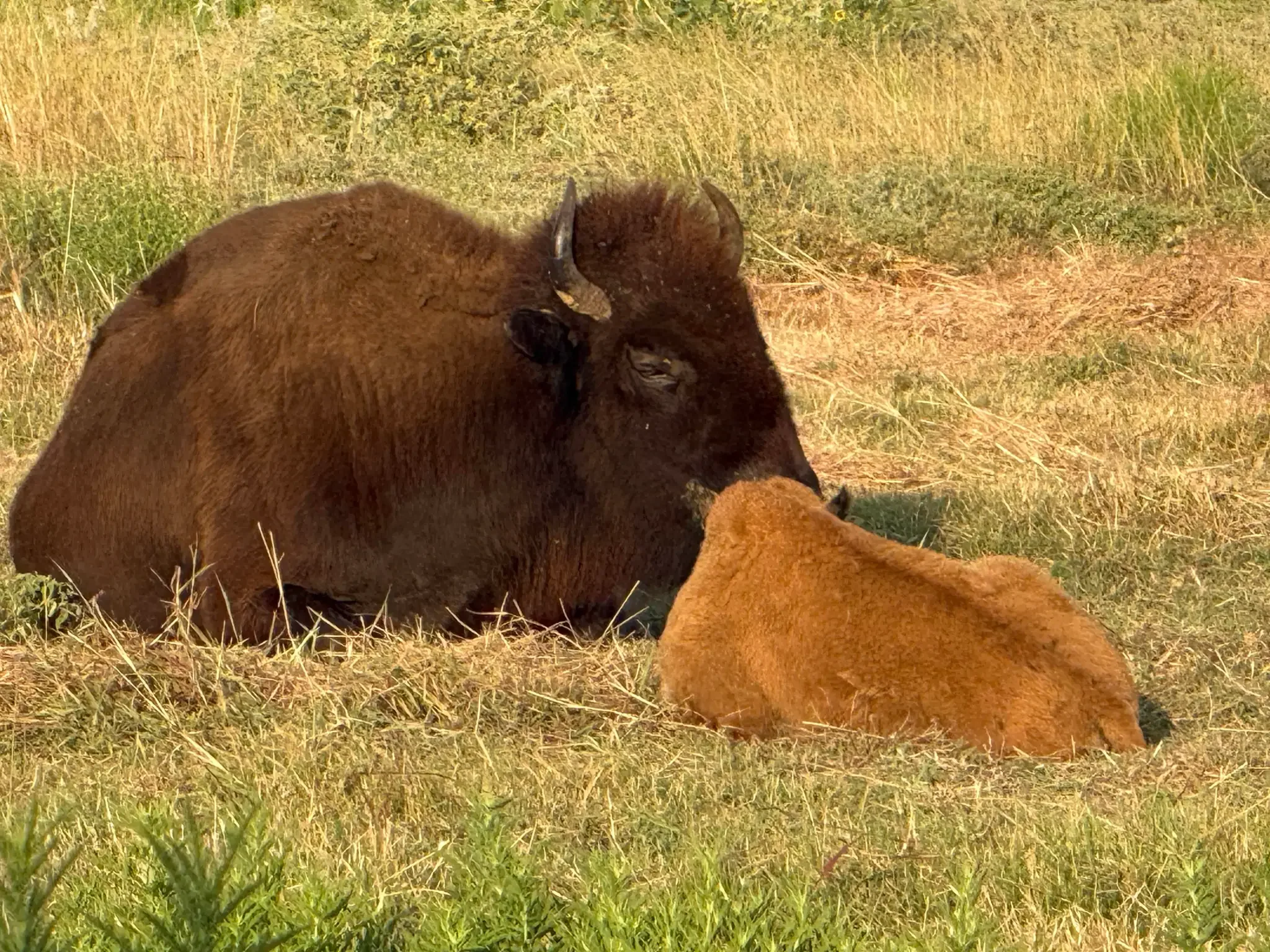
An adult American bison (left) and juvenile (right) at rest. They are a part of the Texas Tribal Buffalo Project’s herd. (Courtesy Texas Tribal Buffalo Project)
A quick note on naming: While the American bison isn’t related to “true” buffalo, some Natives chose to call them “buffalo” when speaking about their historical, spiritual and cultural context. Some also capitalize Buffalo to emphasize the animal’s significance.
The Native-led project also uses the word “iyane’e” for bison.
The project acquired ranch land in Waedler, Texas, in 2021 and began its herd with nine bison. It bought three, five were donated from The Nature Conservancy’s herd, and another came from an anonymous donor.
“Today we have 34 buffalo on two different ranches,” Contreras said. The other is in Florence, Texas.
‘Rematriation’
The women-led project follows principles of “rematriation,” the use of “the indigenous woman’s point of view in governance, in decision-making, and in leadership.”
“It’s viewing everything as a mother — everything that we do is viewed in that point of view,” she said. “As a mother, there’s only unconditional love and support that we have for our families, our children, and our communities.”
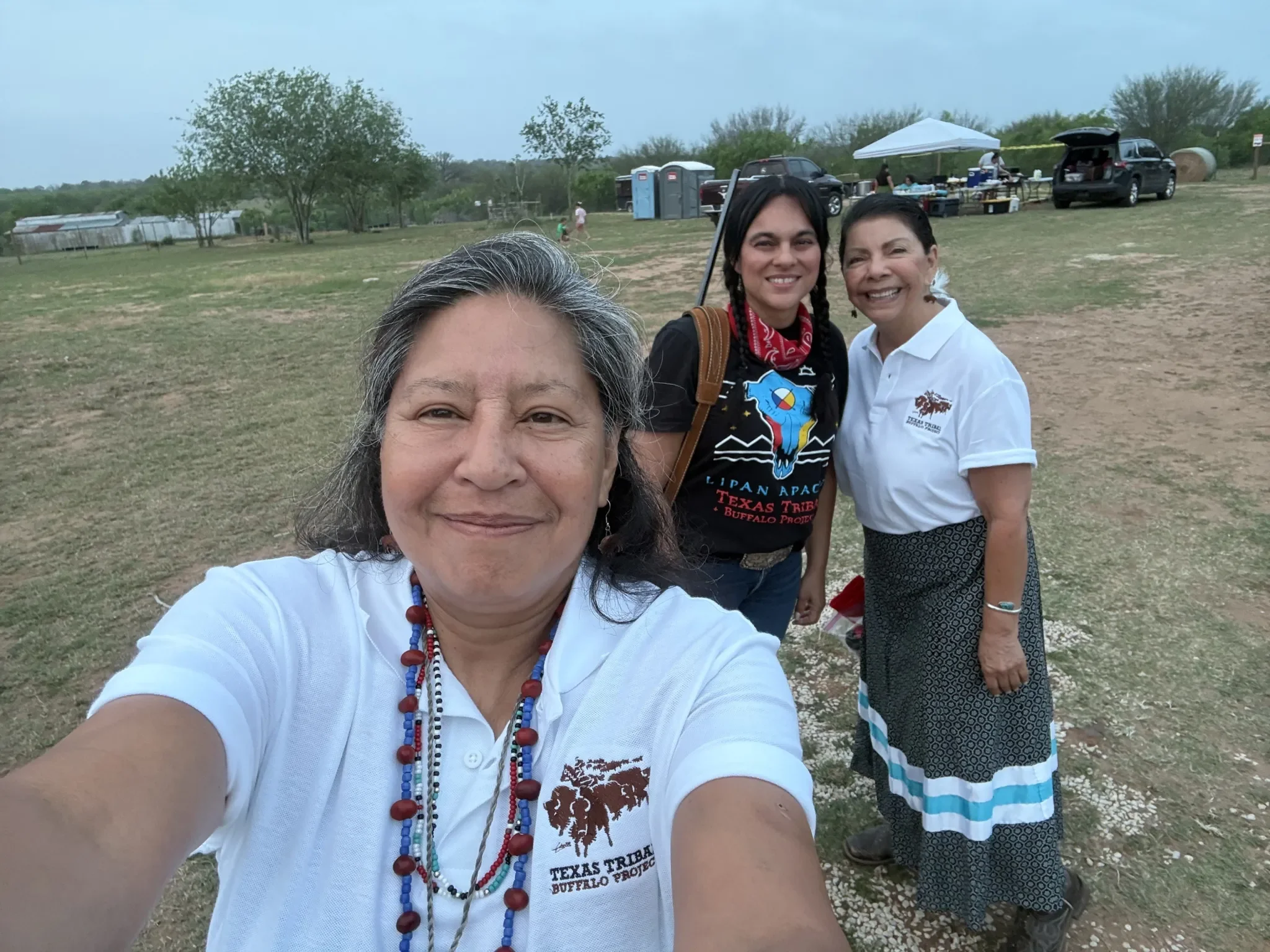
Texas Tribal Buffalo Project Founder Lucille Contreras (left) takes a selfie with TTBP Deputy Director Izel Lopez (center) and another project member. (Courtesy Texas Tribal Buffalo Project)
If the project was only about growing the herd, it likely would avoid killing the bison for their meat. But the group also occasionally harvests some of them for meat; while some is sold, a lot also goes to the community.
“One of our programs is called ‘Meat for Mamas,’ where we distribute meat free of charge to 16 moms for about a year and a half, so throughout pregnancy and then into postpartum,” Contreras said.That program delivers approximately 3 to 5 pounds of bison meat to those Native mothers each month. It means that those new moms don’t have to leave their homes or spend heavily to get the iron- and protein-rich meat.“It’s important to plan for the next generation and all the generations after my lifetime,” Contreras said. “Part of rematriation is a lot of healing … intergenerational healing.”
Harvesting for the community
For context, a harvest-age bison can yield over 500 pounds of meat.
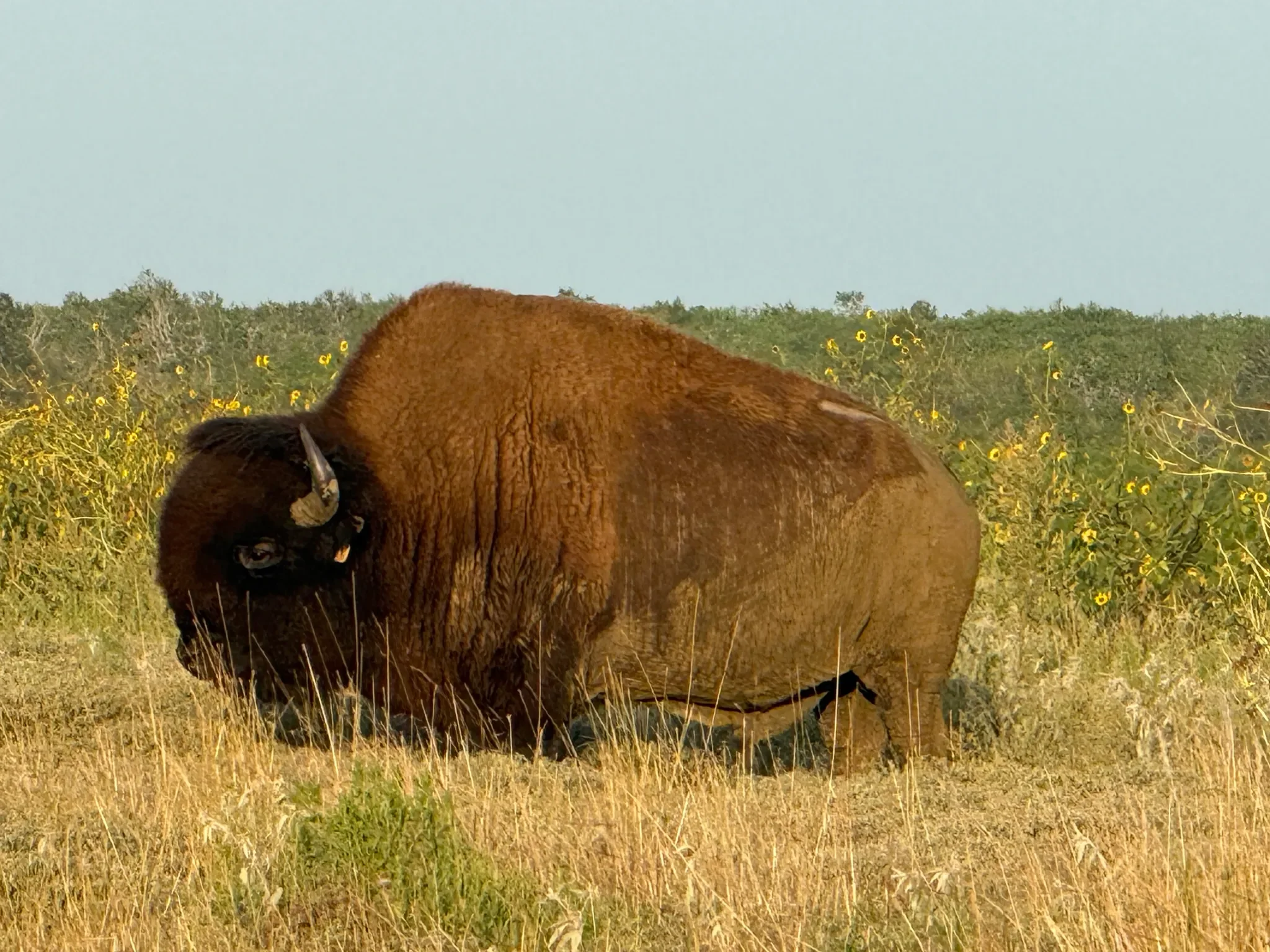
An adult male American bison, part of the Texas Tribal Buffalo Project’s herd. (Courtesy Texas Tribal Buffalo Project)
The Bexar County Health Equity Network received this year’s harvest to stock its food banks. One of those is located at a San Antonio daycare that Contreras attended as a child.
“It just was so, so dear to my heart that here I’m 59 years old and my own little daycare is still in business and they got some meat for their families,” she said.
The project isn’t doing a harvest next year, but is working towards opening a USDA-approved meat processing facility.
Space to roam
The current population estimate for American bison is around 500,000. But before the 1800s, they numbered in the tens of millions.
“At one point in time, the buffalo was everything to our people, home, shelter, food, spirituality, art, tools, supplies, even examples of governance of how to treat each other,” Contreras said.
During the colonization of the American West, the U.S. Army and American hunters killed millions of bison to displace Natives from the land and to clear paths for railroads. The now-national mammal’s population fell to around 100 due to these efforts.
Land ownership and use have always been major policy questions for Texas due to high demand for cattle ranching, oil exploration, and now data centers. Natives likely have never been among those enriched by the decisions of government and business interests.
“It was really brutally taken,” said Contreras about the land.
As it was during the buffalo’s apex and the great slaughter, the bison’s story is ever one of space. It’s a major limit on repopulation efforts; the herds need enough space to roam and graze, and the project’s two properties are at capacity, according to Contreras.
But there’s a phenomenon afoot, she said — older white farmers and ranchers have offered the Native group the first chance to buy up their properties before public listing. The nonprofit is currently on track to acquire new tracts of ranchland in 2027 thanks to a successful capital campaign.
“For Texas Tribal Buffalo Project, the land back aspect is a real natural way for us to continue growing and expanding as our herd grows,” Contreras told KXAN. “It’s really beautiful that the land back movement has we’ve been able to make a small impact in the state of Texas.”